KodeBuilder develops grocery delivery platforms where catalog depth, stock truth and fulfillment speed determine whether customers reorder. We engineer customer apps, picker and warehouse tools, slot engines and rider handoff — for quick-commerce dark stores, neighbourhood kirana digitization, wholesale-to-retail brands and subscription produce boxes. Grocery operations differ fundamentally from restaurant delivery: thousands of SKUs, expiry dates, weight-based pricing and substitution workflows need purpose-built software.
The material on this page is a labelled first-phase design, not a client case study. The illustrative food ordering architecture shows adjacent ordering, payment and fulfilment decisions; it is not a grocery SKU/picker outcome claim.
Grocery Delivery Models We Build For
Each grocery business runs different fulfillment physics. We scope platforms around your operating model before writing code:
- On-demand grocery delivery and quick-commerce dark stores — 10–15 minute delivery from micro-fulfillment centres with tight picker SLAs.
- Scheduled slot delivery — next-day or same-evening windows for planned household shopping.
- Hyperlocal kirana networks — digitizing existing stores with shared catalog, local inventory and store-level pricing.
- Subscription and replenishment — milk, vegetables, staples on recurring cycles with skip/pause controls.
- B2B institutional supply — hotels, canteens and retailers ordering bulk with credit terms and route planning.
Launching with one model and expanding later is common — we design data models and service boundaries so you can add dark stores, new cities or franchise partners without rebuilding core inventory logic.
Catalog, SKU Management and Real-Time Inventory
Grocery catalogs are not menus with modifiers. They carry barcodes, pack sizes, MRP, selling price, tax categories, brand hierarchies, allergens and shelf-life rules. We build:
- Category trees with faceted search (brand, dietary, organic, local)
- Weight- and unit-based products — per kg, per piece, per bundle with decimal quantity support
- Store- or warehouse-level stock with reservation during checkout
- Expiry and batch tracking for perishables and FEFO picking rules
- Promotions, combos, freebies and category-level discounts
- Catalog sync from ERP, POS or spreadsheet imports with validation and diff review
Inventory accuracy is the product. Overselling a staple item once erodes trust faster than a late restaurant order. We implement optimistic locking, stock holds through payment and reconciliation jobs that flag drift between WMS and storefront.
Picker Apps, Warehouse Ops and Fulfillment Benches
Behind every grocery order is a picker walking aisles with a handheld device. Our warehouse and picker tooling includes:
- Pick lists sorted by zone, aisle and batch priority
- Barcode scan validation to prevent wrong-SKU picks
- Substitution prompts with customer-approved alternatives or auto-replace rules
- Weight capture at packing for variable-price items
- Multi-order batch picking for high-volume dark stores
- QC and pack-station workflows before handoff to riders
Picker apps work offline-tolerant in large warehouses with weak signal. Managers see live pick progress, bottleneck alerts and picker productivity dashboards — operational visibility restaurant kitchens rarely need at this scale.
Slot Scheduling, Quick Commerce and Last-Mile Handoff
Delivery promise types vary by model. Slot-based platforms need capacity rules per zone, cut-off times, surge pricing on peak evenings and dynamic slot closure when pick capacity is full. Quick-commerce stacks optimize for sub-15-minute delivery with rider pooling, geofenced service areas and auto-assignment based on picker-ready timestamps.
Rider handoff connects to our driver tracking app development expertise — live GPS, proof of delivery, contact masking, cold-bag verification photos and return-to-store flows for rejected items. Grocery riders often carry mixed ambient and chilled bags; status updates must reflect packing completion, not just kitchen-ready events.
Substitutions, Refunds and Weight-Adjusted Billing
When items are unavailable, customers expect transparent handling. We implement:
- Pre-checkout substitution preferences — replace, refund or contact me
- Post-pick adjustments with push/SMS approval and timed auto-refund fallbacks
- Partial refunds for weight variance on produce and deli items
- Wallet credits, promo restoration and GST-aware invoice corrections
- Audit trails finance teams need for daily reconciliation
Payment capture timing matters: authorize at order, capture after final pick weight, or prepaid with instant refund rails — we align flows with your payment gateway and accounting policies.
ERP, POS, WMS and Supplier Integrations
Grocery operators rarely start from zero systems. We integrate with existing ERP and POS platforms, warehouse management tools, supplier EDI feeds, accounting software and loyalty engines. Webhook and queue-based architectures let catalog, price and stock updates flow without blocking customer checkout during bulk imports.
For brands expanding from physical retail, we plan phased rollout: online catalog mirroring store stock first, then central fulfillment, then dark-store expansion — each phase with measurable inventory accuracy targets.
Grocery Platform Engagement Process
Typical delivery phases:
- Discovery (1–2 weeks) — model selection, catalog size, store count, integration inventory.
- Core commerce (6–10 weeks) — customer app, catalog, cart, payments, basic admin.
- Fulfillment ops (4–6 weeks) — picker app, slot engine, rider handoff, substitutions.
- Scale and integrations (ongoing) — ERP sync, analytics, multi-city rollout, performance tuning.
Pilot launches in one zone or store cluster validate pick accuracy and slot capacity before national expansion.
Operations teams often still chase substitutions and stock-outs in chat. Incoming order alerts, inventory exception queues and permitted customer status notifications can sit beside the grocery platform — see business workflow automation rather than duplicating a full operations suite in the first phase.
Hire Grocery Delivery App Developers
When you hire KodeBuilder for a grocery delivery app, you get one delivery team rather than separate freelancers: a project lead, designer, mobile and backend developers and testing. We agree the first phase in writing before development, and the same team can stay on for changes after launch.
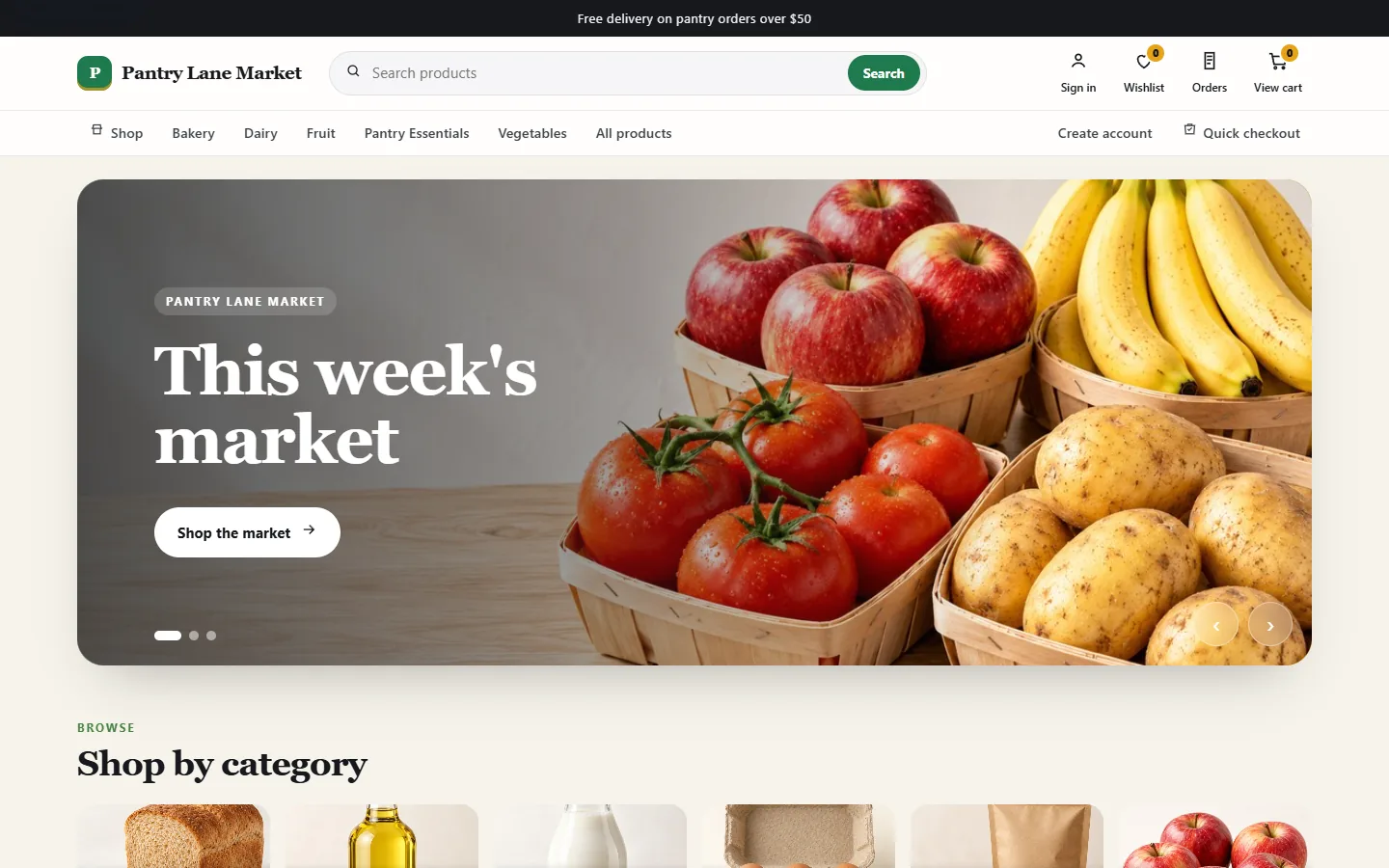
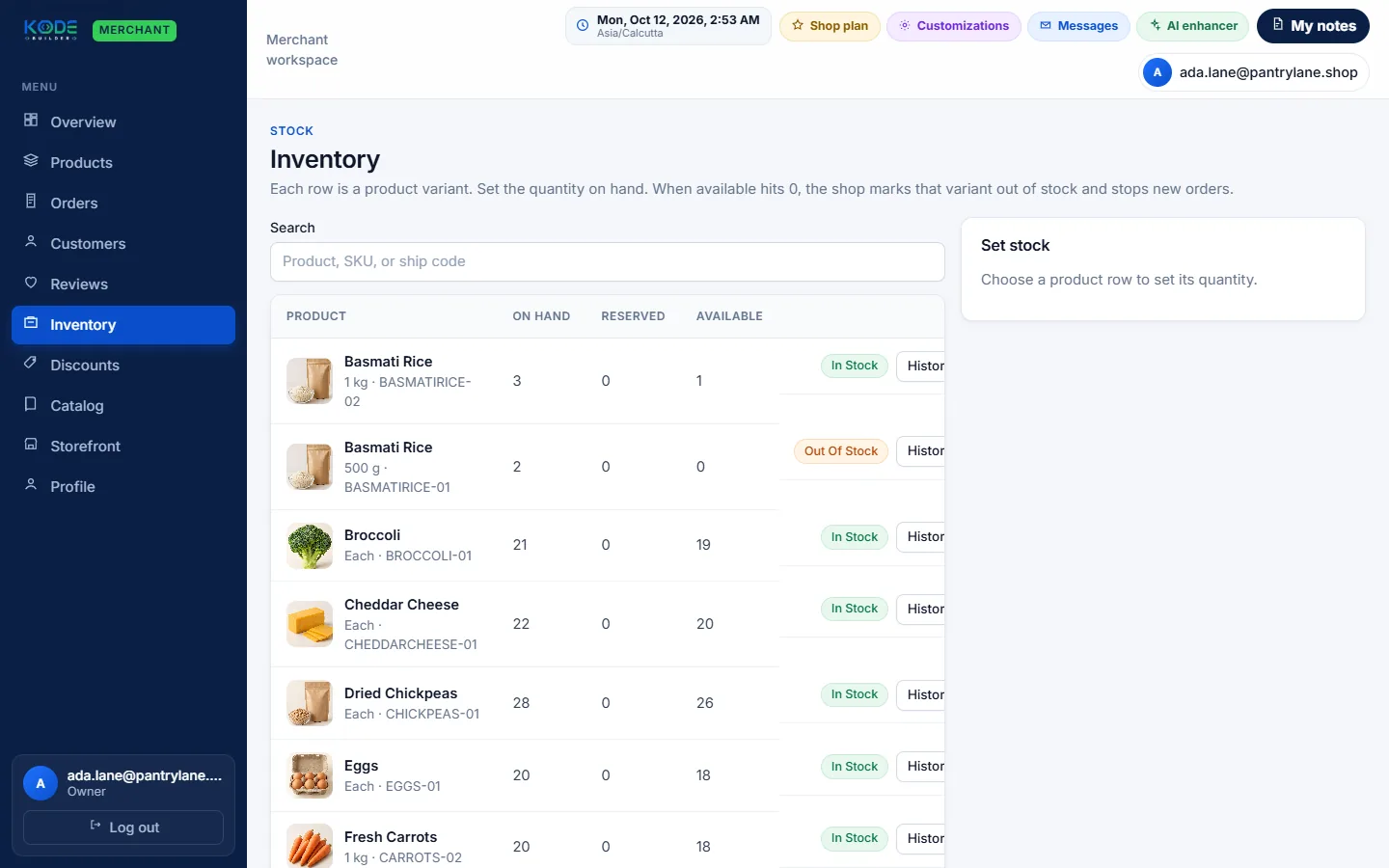
You do not always need a fully custom build. We built KodeBuilder Commerce, our own store builder, and Pantry Lane Market is its grocery demonstration store. If you were looking for a grocery app builder, you can start from that platform and we customise it, or we build the app from scratch when your picking, slot or ERP rules need it.
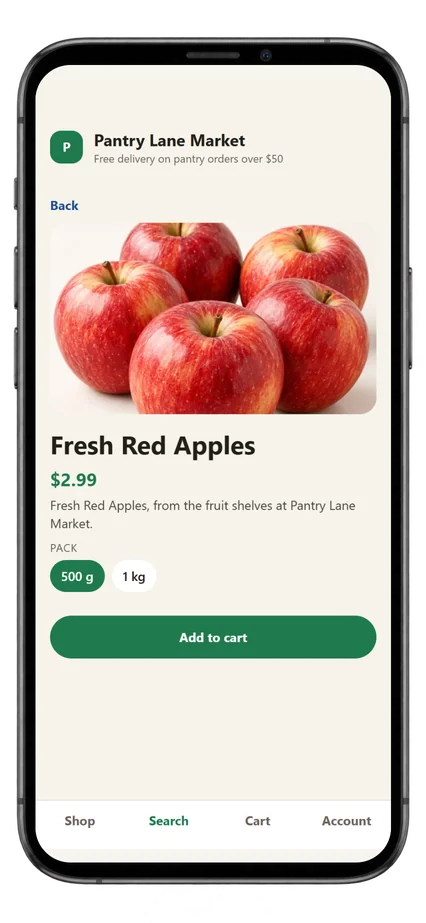
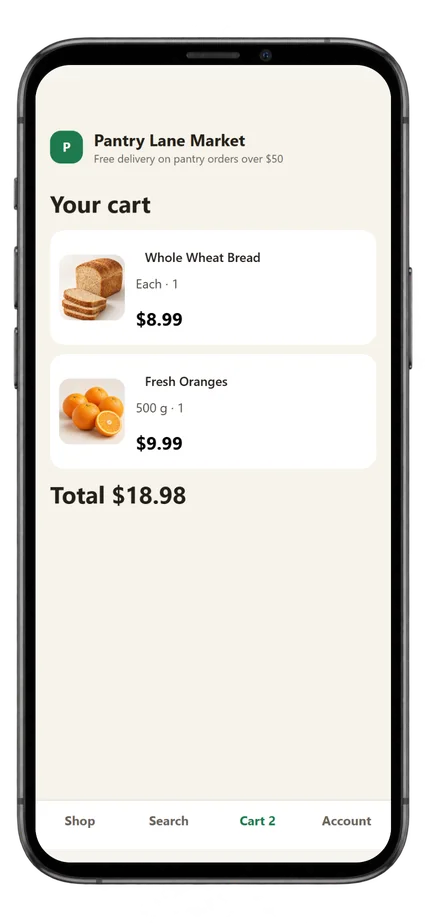
The same store also runs as a mobile app. These are Pantry Lane Market's app screens:
See the full walkthrough on the grocery ecommerce website page.
Grocery delivery app development cost: what drives it
We quote a grocery delivery app after a short discovery, because the price depends on scope rather than on the word "app". The main cost drivers are:
- Catalogue size and pricing rules — a few hundred SKUs with fixed prices is far simpler than weight-based pricing, store-level prices and expiry tracking.
- Apps in the first phase — customer app only, or customer, picker, rider and admin apps together.
- Delivery model — scheduled slots are simpler than on-demand dispatch with live tracking.
- Integrations — ERP, POS, WMS or supplier feeds each add build and testing time.
- Starting point — starting from KodeBuilder Commerce costs less than a fully custom build, because the storefront, cart, inventory and merchant workspace already exist.
For cost ranges and how phases are priced, see the delivery app development cost guide, or ask for an estimate for your grocery app.
Phased grocery launches for small and growing businesses
You do not need a national quick-commerce stack to start. A practical sequence is:
- One store or delivery zone
- Customer ordering and basic administration
- Inventory and picker operations
- Rider dispatch and tracking
- Additional stores, suppliers and analytics
We design the first phase so later stores and integrations can be added without rebuilding catalog and stock logic. Feature detail lives in our grocery delivery app features guide. Mobile delivery is covered on mobile app development in India.
Frequently Asked Questions About Grocery Delivery Apps
Yes, for a single grocery store. KodeBuilder Commerce is our own store builder with a storefront, inventory and a merchant workspace, and it has a free plan for up to 25 products. iOS and Android apps for the store are available at extra cost. When you need picker, slot or rider workflows, we build the grocery delivery app around your business instead.
Grocery platforms manage large SKU catalogs, warehouse picking, expiry dates, weight-based pricing and substitution workflows. Food delivery focuses on restaurant menus, kitchen preparation and short prep-to-delivery cycles. The backend, ops apps and inventory models are materially different.
Yes. We design slot engines and on-demand dispatch as configurable modules so you can offer instant delivery in dense zones and scheduled slots in suburban areas from one platform.
Yes. We integrate catalog, stock and order data with common ERP, POS and WMS systems via APIs, file imports or middleware — scoped during discovery based on your current stack.
Pickers flag unavailable items in the warehouse app. Customers receive approval requests with alternatives, or pre-set rules auto-replace or refund. All adjustments flow to billing and notifications before delivery.
We deliver customer apps on iOS and Android (React Native or Flutter), responsive web storefronts, picker and admin web dashboards, and optional rider apps — all backed by a shared API and real-time order state.
It depends on catalogue size, which apps you need in the first phase, the delivery model and integrations. We quote after a short discovery. Starting from KodeBuilder Commerce usually costs less than a fully custom build.